






Introduction
Total knee replacement is a well-established procedure for patients with advanced knee osteoarthritis. It is indicated for patients with pain, stiffness, and difficulty in performing daily activities and those who had failed non-surgical treatment. During the procedure, damaged surfaces of the knee joint are replaced with artificial implants for pain relief, improved movement, and to restore function. ¹
In recent years, robotic-assisted knee replacement has become increasingly available, as it provides patients with another surgical option alongside the traditional approach. Although both procedures aim to achieve the same outcome, the difference lies in their planning and implant positioning. ¹ Understanding these differences helps patients to have informed discussions with their orthopedic surgeon and make confident treatment decisions.
What Is Traditional Knee Replacement?
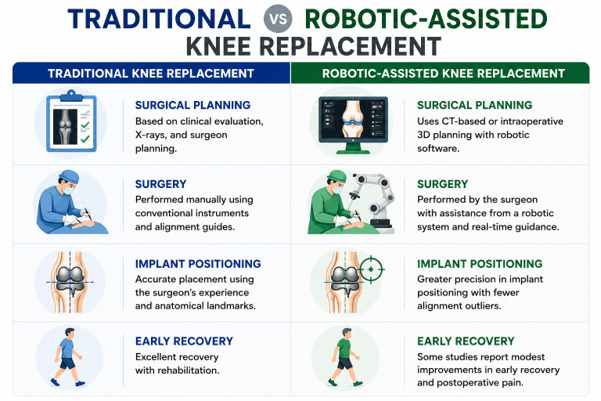
Traditional knee replacement, also known as conventional total knee arthroplasty, is a manual procedure performed using standard surgical instruments and alignment guides. In this method, the knee is evaluated before surgery by the surgeon using clinical examination and imaging, and the procedure is planned. During surgery, damaged bone and cartilage are removed, and the implant is positioned using anatomical landmarks and surgical instruments depending on the surgeon’s experience. ¹
Conventional TKA has demonstrated proven efficacy and reproducibility and continues to be the standard surgical approach due to its positive clinical outcomes and shorter operative time. ³
What Is Robotic-Assisted Knee Replacement?
Robotic-assisted knee replacement follows surgical procedures that are like conventional knee replacement but incorporates robotic technology to assist the surgeon with planning and implant positioning. Depending on the robotic platform used, planning may be based on a preoperative CT scan or a 3D digital map created during surgery. ¹ The goal is to improve the accuracy and consistency of implant placement compared with conventional techniques. ¹, ²
Despite its name, robotic-assisted surgery is not performed by the robot alone. The surgery is performed by the orthopedic surgeon and is completely under the surgeon’s control throughout the procedure, while the robotic system serves as an assistive tool. ¹
Robotic vs Traditional Knee Replacement: Key Differences
The main aim of both approaches is to relieve pain, improve mobility, and restore knee function. The main difference is the use of robotic technology used to assist the surgeon during the procedure rather than the overall goal of treatment. ¹
Does Robotic-Assisted Knee Replacement Offer Better Results?
Studies have demonstrated that robotic-assisted knee replacement improves implant positioning accuracy and reduces alignment errors. ¹, ², ³ This means the surgeon is more likely to achieve the planned implant position during the operation.
While improved surgical precision does not automatically mean better patient outcomes. Studies comparing both the procedures have shown comparable results of long-term pain relief, knee function, patient satisfaction, complication rates, and revision rates. ¹, ², ³
Modest improvements in early recovery, lower postoperative pain, shorter hospital stays, and reduced soft tissue injury have also been reported with robotic procedure. However, these findings have not been consistently observed across all studies. ¹, ², ³
Overall, both surgical options are effective. But the success of surgery depends on several factors, such as appropriate patient selection, surgeon experience, implant selection, and postoperative rehabilitation. ¹, ²
Which Procedure May Be Right for You?
There is no single surgical approach that is suitable for every patient. Factors such as the severity of arthritis, knee anatomy, overall health, history of surgeries, availability of robotic technology and the surgeon’s expertise influence the choice of procedure. ¹, ²
The potential risks, benefits, limitations, expected recovery, and long-term outcomes of each approach should be discussed with the surgeon to determine the most appropriate treatment plan suitable for the patient. ¹, ²
Key Takeaways
- Traditional and robotic-assisted knee replacements are both effective treatments for advanced knee osteoarthritis. ¹
- Robotic technology assists the surgeon in the precision of surgical planning and implant positioning but does not replace the surgeon. ¹, ²
- Current evidence in robotic-assisted surgery shows better implant alignment, while long-term pain relief, knee function, and patient satisfaction are broadly comparable in both approaches. ¹, ², ³
- The overall success of knee replacement depends on patient selection, surgical expertise, and commitment to rehabilitation after surgery. ¹, ²
References
1. Fu X, She Y, Jin G, Liu C, Liu Z, Li W, et al. Comparison of robotic-assisted total knee arthroplasty: An updated systematic review and meta-analysis. J Robot Surg. 2024;18:292.
2. Alrajeb R, Zarti M, Shuia Z, Alzobi O, Al-Horani RA, Al Azzam M, et al. Robotic-assisted versus conventional total knee arthroplasty: A systematic review and meta-analysis of randomized controlled trials. Eur J Orthop Surg Traumatol. 2024;34:1333-1343.
3. Wang H, et al. Robotic-assisted versus conventional total knee arthroplasty: A systematic review and meta-analysis. Medicine (Baltimore). 2025.
Frequently Asked Questions
Robotic-assisted knee replacement improves the accuracy of implant positioning and alignment. However, evidence suggests that long-term pain relief, knee function, and patient satisfaction are generally similar between the procedures. ¹, ², ³
No. The surgery is performed by an orthopedic surgeon. The robotic system assists the surgeon in planning and real-time guidance. It does not make surgical decisions or operate independently. ¹
Some studies reported that robotic-assisted surgery provides a slightly faster early recovery and lower postoperative pain. However, it varies between patients and depends on several factors, including rehabilitation and overall patient health. ¹, ², ³
No. The choice of the most appropriate approach depends on the patient’s conditions, such as knee anatomy, overall health, and the surgeon’s assessment. Both procedures remain well-established treatment options. ¹, ²








Leave a comment