






How Hip Implant Design Is Evolving in India
A hip implant is not simply a “metal joint.” It is a combination of components designed to replace damaged parts of the hip and help restore mobility. In total hip replacement, the femoral head—the ball at the top of the thigh bone, and the acetabulum the socket in the pelvis are replaced with artificial components. [1]
Hence, the important question from a patient can be: “Which implant is appropriate for my anatomy, bone quality and surgical needs?” Implant selection involves consideration of patient-related factors, implant characteristics and surgical factors. The most suitable option depends on an individual assessment by the treating surgeon. [2]
Indian manufacturers, including Biorad Medisys, offer hip replacement systems with different component designs, sizes and material options. These choices provide surgeons with options to consider when planning treatment for individual patients.
Key Takeaways
- Hip implants differ in fixation, design, materials, size and bearing surface.
- Titanium alloys, cobalt-chromium alloys, polyethylene and ceramics are commonly used materials for hip implants. [2]
- Studies of Indian patients show that the anatomy of the upper thigh bone near the hip can differ from Western reference data, making implant fit and sizing important. [3][4]
- Indian and foreign implants should be compared on evidence, quality, design and patient suitability; not origin alone. [2][7]
- Biorad Medisys offers uncemented hip systems with multiple material and size options. [5][6]
What Is a Hip Implant?
Think of the natural hip as a ball moving inside a socket. Hip replacement recreates this movement with artificial components.
Total hip arthroplasty (THA) replaces both sides of the joint: the femoral head (the ball at the top of the thigh bone) and the acetabulum (the socket in the pelvis). In hemiarthroplasty, or partial hip replacement, only the femoral head is replaced, while the natural acetabulum is retained. [1]
What Are the Different Types of Hip Implants?
Hip replacement procedures and implant systems can be classified in several ways, including the type of surgery, fixation method and bearing configuration:
- By procedure: Total hip replacement and hemiarthroplasty.
- By fixation: Cemented and uncemented fixation.
- By clinical situation: Primary and revision hip replacement.
- By bearing configuration: Conventional and dual-mobility systems, where appropriate
Indian registry data show an increasing preference for uncemented total hip replacement, along with growing interest in dual-mobility systems. [7]
What Are the Components of a Hip Implant?
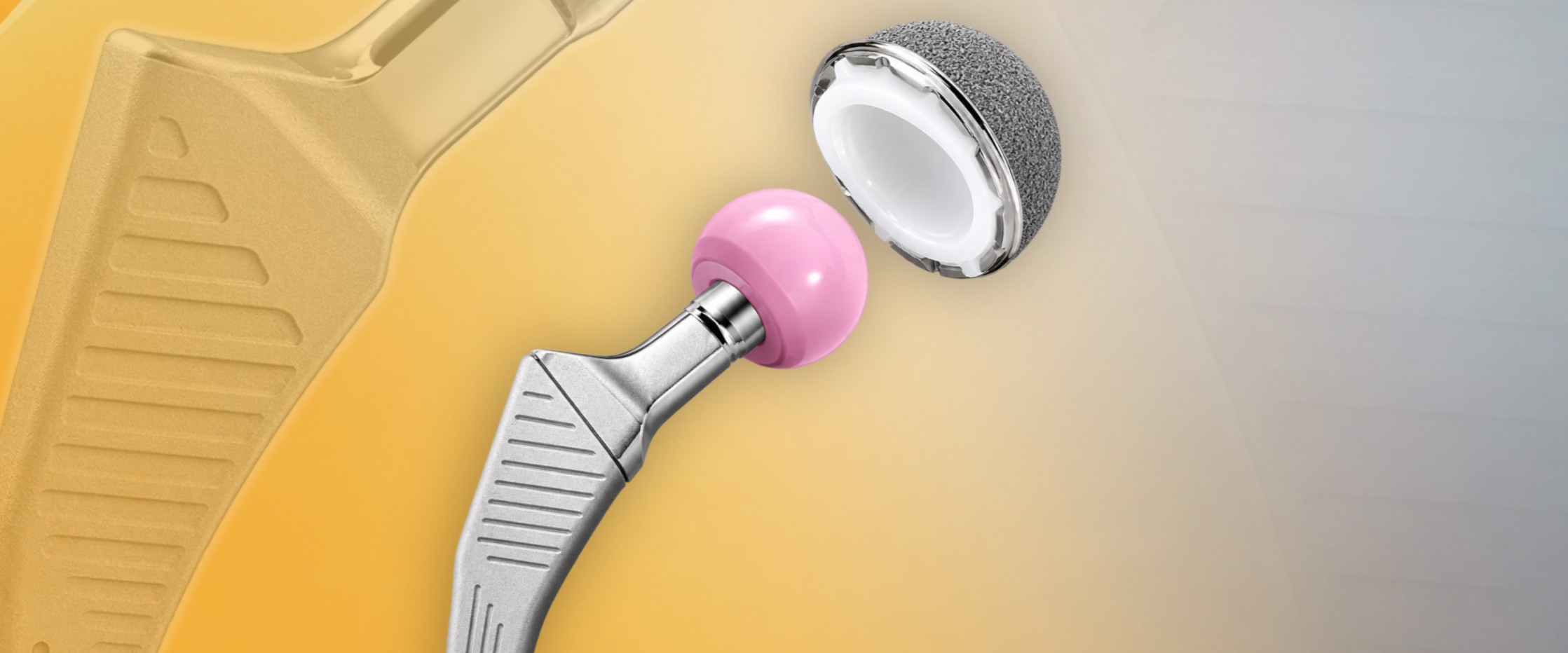
A total hip replacement usually includes four main components:
- Femoral side: Femoral stem and femoral head.
- Acetabular side: Acetabular cup and liner.
The femoral stem is placed inside the femur, or thigh bone, and supports the femoral head. The femoral head forms the ball of the replacement joint. On the pelvic side, the acetabular cup is positioned in the prepared socket, while the liner sits inside the cup and provides the surface that articulates with the femoral head.
Availability of different component sizes and configurations can give surgeons more options when selecting an implant system for an individual patient’s anatomy and surgical requirements.
What Materials Are Used in Hip Implants?
Hip implants use different materials because each component has a different function.
| Material | Common use |
|---|---|
| Titanium alloy | Femoral stems and acetabular cups |
| Cobalt-chromium alloy | Some femoral heads |
| Polyethylene / Highly Cross-Linked Polyethylene (HXLPE) | Acetabular liners |
| Ceramic | Femoral heads and selected bearing combinations, including ceramic-on-polyethylene and ceramic-on-ceramic |
A major review of THA biomaterials groups the main materials into polymers, metal alloys and ceramics. It also explains that wear resistance, biocompatibility, corrosion resistance and mechanical properties all influence material selection. [2]
Biorad Medisys’s SIGNATURE system reflects this multi-material approach with components made from Titanium–6% Aluminium–4% Vanadium, Extra Low Interstitial (Ti6Al4V ELI), highly cross-linked polyethylene liners and ceramic femoral head options. [6]
How to Choose the Right Hip Implant?
There is no single hip implant that is right for every patient.
A surgeon may consider:
- patient age and activity,
- bone quality,
- femoral and acetabular anatomy,
- fixation method,
- implant geometry and size,
- bearing materials,
- clinical evidence,
- experience with the implant system.
The choice of an appropriate implant depends on the patient’s anatomy and clinical needs, the implant’s design and characteristics, and the surgeon’s assessment. A range of sizes and configurations may provide additional options when selecting a suitable system for an individual patient. [2]
Biorad Medisys highlights the importance of offering a range of implant sizes, designs, and configurations to support different patient anatomies and surgical requirements.
Hip Implants Designed for the Needs of Indian Patients
This is one of the most important areas where the Indian market is evolving.
A study of proximal femoral morphology in a South-West Indian population reported differences in certain measurements across population subsets and between sexes. It also identified differences when its measurements were compared with Western reference data. [3]
Another Indian study concluded that population-specific measurements can help in designing hip prostheses suitable for Indian patients. [4]
This does not mean every Indian patient needs an “Indian implant.” It means implant ranges should provide enough sizes and geometries to match individual anatomy.
How Should Indian and Imported Hip Implants Be Evaluated?
The country of manufacture alone is not sufficient to determine whether a hip implant is appropriate for a patient.
India has both national and multinational implant manufacturers. Indian registry literature also highlights that long-term surveillance and registry data are essential for understanding how implants perform over time. [7]
A more meaningful way to compare hip implants is to consider:
Country of manufacture alone should not decide the choice.
Biorad Medisys Hip Implant Portfolio
Biorad Medisys offers hip replacement systems with different stem and acetabular component designs, materials and configurations. The following examples illustrate the available options across its portfolio.
Its portfolio includes:
- SIGNATURE: an uncemented hip system with titanium stem and cup, HXLPE liner and metal or ceramic head options. [6]
- AVATAR NX: an uncemented system with Hydroxyapatite (HA)-coated, double-tapered stem with multiple head and liner configurations. [5]
- SIGNATURE NX: a trabecular acetabular cup system available in cluster-hole and multi-hole designs. [6]
The AVATAR NX literature, for example, describes a forged Ti6Al4V ELI stem with HA coating, metaphyseal flare and vertical and horizontal grooves. [5]
Together, these systems reflect three important areas in current hip replacement: fixation, material choice and component flexibility.
Hip Implant Manufacturing and Quality Control
In India, medical devices are regulated under the Medical Devices Rules, 2017, as amended. Applicable requirements address matters such as safety, performance, manufacturing controls and regulatory compliance. The specific requirements depend on the device and the relevant regulatory provisions. [8]
A simple way to understand the quality pathway is:
For patients and healthcare professionals, transparent information about product specifications, applicable regulatory compliance and available clinical evidence provides a more useful basis for evaluating implant systems than marketing claims alone.
Hip implant selection involves consideration of anatomy, fixation, materials, component design and available clinical evidence. Manufacturers such as Biorad Medisys offer different hip implants, providing surgeons with options to consider when planning treatment for individual patients.
References
- [1] American Academy of Orthopaedic Surgeons, American Joint Replacement Registry. Patient-facing interim report on hip & knee arthroplasty data. https://www.orthoinfo.org/globalassets/pdfs/aaos_ajrr_2018-patient-supplement.pdf
- [2] Khalifa, A.A., Bakr, H.M. Updates in biomaterials of bearing surfaces in total hip arthroplasty. Arthroplasty 3, 32 (2021). DOI: https://doi.org/10.1186/s42836-021-00092-6
- [3] Kamath SU, Agarwal S, Austine J. Morphology of proximal femur in South-West Coast of India. Malaysian Orthopaedic Journal. 2020;14(3). DOI: https://doi.org/10.5704/MOJ.2011.022
- [4] Verma M, et al. Morphometry of proximal femur in Indian population. Journal of Clinical and Diagnostic Research. 2017;11(2) AC01–AC04. DOI: https://doi.org/10.7860/JCDR/2017/23955.9210
- [5] Biorad Medisys. AVATAR NX uncemented hip system. Product literature. https://www.orthovasive.com/product/avatar-nx-stem/
- [6] Biorad Medisys. SIGNATURE hip replacement system and SIGNATURE NX. Product literature. https://www.orthovasive.com/product/signature-multi-hole-signature-stem/
- [7] Vaidya SV, et al. India joining the world of hip and knee registries: Present status—a leap forward. Indian Journal of Orthopaedics. 2021;55(Suppl 1) S46–S55. DOI: https://doi.org/10.1007/s43465-020-00251-y
- [8] Central Drugs Standard Control Organization. Medical Devices Rules, 2017. Ministry of Health and Family Welfare, Government of India; 2017. https://cdsco.gov.in/opencms/opencms/en/Acts-and-rules/Medical-Devices-Rules
Frequently Asked Questions
Your surgeon will usually consider hip anatomy, bone quality, age, activity level, fixation method and implant design before recommending a system.
Common materials include titanium alloys, cobalt-chromium alloys, polyethylene and ceramics. [2]
Medical devices in India are regulated under the Medical Devices Rules, with applicable BIS and, where required, ISO/IEC. [8]
Current evidence does not support choosing a hip implant simply on whether it is Indian or imported. Implant design, fit, materials, quality standards, available clinical evidence and surgeon experience are more useful considerations. [2][7]
Yes. Biorad Medisys offers uncemented hip replacement systems, including SIGNATURE, SIGNATURE NX and AVATAR NX, with different component sizes, materials and design options. [5][6]








Leave a comment