






Introduction
The terms “arthritis” and “osteoarthritis” are often used interchangeably, but they are not quite the same thing. Arthritis literally means joint inflammation,1 and osteoarthritis is a type of arthritis.2
Joint problems are far more common than most people realize. The prevalence of arthritis in India alone accounts for 180 million, making it a condition more prevalent than diabetes or heart disease. It leads to chronic pain, joint deformities, and restrict the movements often making everyday activities difficult.3 In 1990, 23.46 million Indians suffered from osteoarthritis, and this number rose to 62.35 million by 2019.5
Patients often struggle to understand the difference between these two conditions because several joint conditions fall under the broad “arthritis” category.
Arthritis vs Osteoarthritis: What’s the Difference?
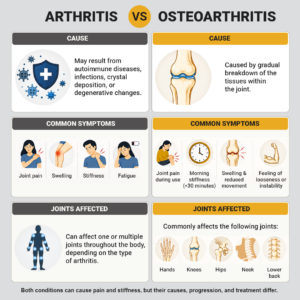
Arthritis is best understood as an umbrella term. It is defined as acute or chronic joint inflammation that often co-exists with pain and structural damage, and more than 100 different types have been identified.5 This umbrella includes osteoarthritis, rheumatoid arthritis, psoriatic arthritis, gout, ankylosing spondylitis, and arthritis associated with systemic lupus erythematosus.3
Osteoarthritis is one of the most common types of arthritis worldwide causing chronic pain and disability in adults.4 It is a degenerative joint disease in which the tissues within the joint gradually break down over time, and unlike many other forms of arthritis, it is not primarily driven by inflammation.2,5 In essence, every case of osteoarthritis is a form of arthritis, but not every type of arthritis is osteoarthritis.
Recognizing the Symptoms
| Symptoms of Arthritis 5 | Symptoms of Osteoarthritis 2,6 |
|---|---|
|
|
Who Is at Risk?
Several factors can raise the risk of developing arthritis. Risk increases with age, and most types are more common in women, while gout is more common in men. A family history of arthritis, being overweight or obese, joint injuries, infections, and smoking can also contribute to the likelihood of developing the condition.7
Certain factors increase the likelihood of developing osteoarthritis. These include aging, being overweight or obese, a history of joint injury or surgery, repetitive overuse of a joint, joints that did not form correctly, and a family history of the condition. Women are at higher risk than men, particularly after age 50, and the condition often develops after menopause.2,6
When Should Joint Pain Be Evaluated?
Joints should be evaluated for arthritis in case of 5
- Persistent or worsening joint pain
- Pain accompanied by swelling, stiffness, or loss of function
- Pain worse with activity and toward the end of the day
- Pain alongside fatigue or stiffness
Evaluation of osteoarthritis is done in case of 6
- Persistent, worsening pain interfering with daily activities
- Pain worse with activity, better with rest
- Age over 45
- Morning stiffness lasting under 30 minutes
- Bony joint enlargement
- Noticeable limitation in range of motion
Diagnosis and Management
Diagnosis begins with plain radiographs to find out joint space narrowing, osteophytes, and effusion. MRI may be used to get more details on synovitis, erosions, or sacroiliitis.5 Arthritis is a clinical diagnosis, confirmed by activity-related pain, age over 45, morning stiffness <30 minutes, bony enlargement, and limited range of motion.6
Treatment aims at reducing pain and minimizing the loss of function through non-pharmacologic measures such as avoiding activities that stress the joints, strengthening exercises, weight control, physical therapy, acupuncture, and use of supportive devices such as braces, splints, canes, or crutches. This can be combined with pharmacologic options including oral, topical, or intra-articular medications as required.5,6
Key Takeaways
Arthritis is a group of joint conditions that involves inflamação. On the other hand, osteoarthritis is one of the types of arthritis resulting from slow joint tissue degeneration over time. Patient understanding towards this differentiation allows them to identify their symptoms bette and engage in moreinformed discussions with doctors about best course of action.
References
1. National Institute of Arthritis and Musculoskeletal and Skin Diseases. Arthritis [Internet]. Bethesda (MD): NIAMS; [cited 2026 Jun 30]. Available from: https://www.niams.nih.gov/health-topics/arthritis
2. National Institute of Arthritis and Musculoskeletal and Skin Diseases. Osteoarthritis [Internet]. Bethesda (MD): NIAMS; [cited 2026 Jun 30]. Available from: https://www.niams.nih.gov/health-topics/osteoarthritis
3. Mission Arthritis India. An overview of arthritis [Internet]. [cited 2026 Jun 30]. Available from: https://www.missionarthritis.org/article/106/an-overview-of-arthritis
4. Singh, A., Das, S., Chopra, A., et al. (2022). Burden of osteoarthritis in India and its states, 1990-2019: findings from the Global Burden of disease study 2019. Osteoarthritis and cartilage, 30(8), 1070–1078. https://doi.org/10.1016/j.joca.2022.05.004
5. Sen R, Hurley JA. Osteoarthritis. In: StatPearls [Internet]. Treasure Island (FL): StatPearls Publishing; [updated date unknown; cited 2026 Jun 30]. Available from: https://www.ncbi.nlm.nih.gov/books/NBK518992/
6. Senthelal S, Li J, Ardeshirzadeh S, Thomas MA. Arthritis. In: StatPearls [Internet]. Treasure Island (FL): StatPearls Publishing; [updated date unknown; cited 2026 Jun 30]. Available from: https://www.ncbi.nlm.nih.gov/books/NBK518992/
7. Centers for Disease Control and Prevention. Arthritis Risk Factors [Internet]. Atlanta (GA): CDC; [cited 2026 Jun 30]. Available from: https://www.cdc.gov/arthritis/risk-factors/index.html
Frequently Asked Questions
No. Out of the more than 100 forms of arthritis, and osteoarthritis is the most common type that is non-inflammatory.
Risk factors such as overweight and overuse of joints, can be managed, but others such as aging and family history cannot be modified.
No. Currently there is no cure for osteoarthritis. But a combination of lifestyle changes and treatment can help in managing the pain and preserve function over time.





Deixe um comentário