






Introduction
Knee pain is one of the most common complaints among elderly individuals, affecting an estimated 22% to 47% of the population in India.1 Many people first try medicines, physiotherapy, or lifestyle changes to manage the pain. But this pain interferes with everyday tasks such as walking, standing, or even sitting on the floor. Then, replacement of knees would become only reliable options for people.
Over the years, this surgery has become one of the most successful treatments for reducing pain and restoring mobility. Recently, a newer and more advanced version of robotic-assisted knee replacement has become popular. This technology gives a free hand to surgeons in planning and executing the procedure, based on patient specific requirements.
What Exactly Is Robotic-Assisted Knee Replacement?
The term “robotic surgery” often misleads people that the robot performs the operation independently, but that is not true. The surgeon remains fully in control at every step. In this surgery, the robotic system is more like a skilled assistant who helps to restore the patient’s natural knee alignment using image-assisted technology. While doing that, perform minimal or no soft tissue release during the procedure. This further leads to less post-surgical problems that patients often face.
How does Robotic Knee Replacement Work?
To understand the working of robotic knee replacement procedures, knowing how this system plays a role in different phases of surgery is vital.
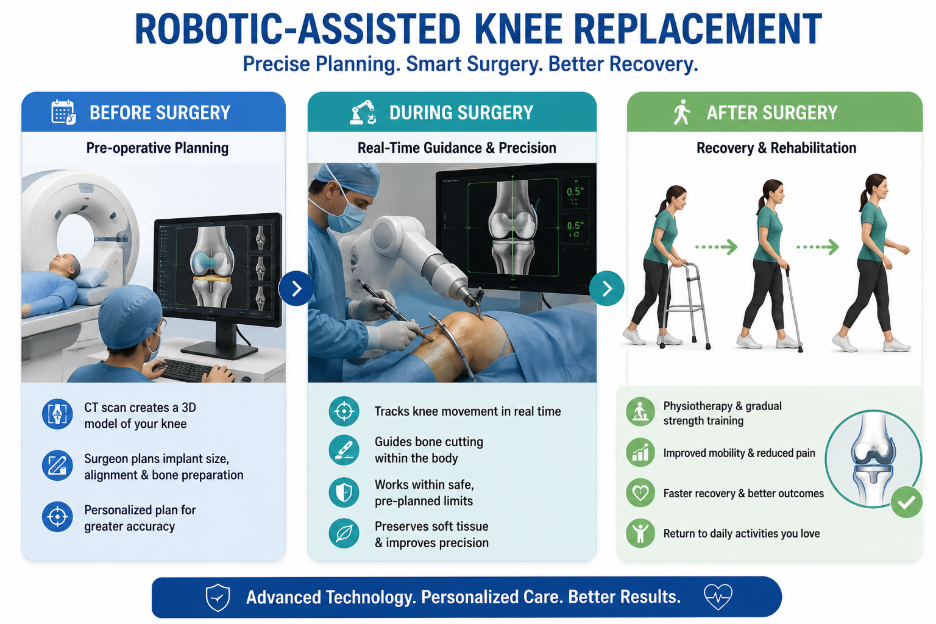
- Before surgery: The robotic system creates a 3D model of the knee through a CT scan which can be used by surgeon to plan implant size, alignment, and bone preparation in advance.
- During surgery: Additionally, this robotic approach keeps records of each movement of the knee in real time, helps to provide better surgical impact for knees. It ensures safe, pre-planned limits, helping preserve soft tissue, and improving precision.
- After surgery: The post-surgical outcome of robotic knee replacement surgery is improved with physiotherapy and gradual strengthening.
What Does Latest Studies Show?
Patient undergoing robotic-assisted knee replacement had better pain relief and higher joint-awareness (termed as “Forgotten Joint)” scores at 12 weeks compared to conventional surgery.2
Another systematic study revealed that robotic total knee replacement using the MAKO system produced better functional recovery scores compared to manual surgery, based on results collected over the medium term. 3
List of Robotic Knee Surgery Benefits 4
Across these studies, the recurring advantages include:
- More accurate implant placement and knee alignment
- Better soft tissue preservation
- Reduced variability during surgery
- Better pain relief in the early weeks after surgery
- High patient satisfaction
Who Should Consider This Surgery?
This option may suit people who have advanced osteoarthritis, ongoing pain despite conservative treatment, difficulty with daily activities, and who are assessed as suitable candidates by an orthopedic surgeon.5
The Bottom Line
Robotic-assisted knee replacement is a genuine step ahead, especially for early pain relief, precision, and patient satisfaction in patients with knee related problems. Moreover, the benefits and surgical accuracy of surgery are grabbing more attention from people. There are awareness and choice of surgical approach that still depend on the patient’s health condition, severity of disorder and availability of resources. Nonetheless, this surgical option is a good and efficient solution for patients with knee replacements issues.
Sources:
- Daniel, R. A., Kalaivani, M., Aggarwal, P., & Gupta, S. K. (2025). Prevalence of knee osteoarthritis among elderly persons in India: A systematic review and meta-analysis. Journal of family medicine and primary care, 14(5), 1675–1684. https://doi.org/10.4103/jfmpc.jfmpc_1254_24
- Alton, T. B., Severson, E. P., Ford, M. C., Lesko, J., & Leslie, I. J. (2025). VELYS robotic-assisted total knee arthroplasty: Enhanced accuracy and comparable early outcomes versus manual instrumentation during adoption. Journal of experimental orthopaedics, 12(1), e70163. https://doi.org/10.1002/jeo2.70163
- Sodhi, K., Eaton-Brown, J., Kumar, P. R., Adebayo, O., Searle, H. K. C., Metcalfe, A. J., Davis, E. T., & Khatri, C. (2025). Robotic-assisted total knee arthroplasty with MAKO is associated with improved functional outcomes : a systematic review and meta-analysis. Bone & joint open, 6(11), 1382–1393. https://doi.org/10.1302/2633-1462.611.BJO-2025-0180.R1
- Mancino, F., Cacciola, G., Malahias, M. A., De Filippis, R., De Marco, D., Di Matteo, V., A, G., Sculco, P. K., Maccauro, G., & De Martino, I. (2020). What are the benefits of robotic-assisted total knee arthroplasty over conventional manual total knee arthroplasty? A systematic review of comparative studies. Orthopedic reviews, 12(Suppl 1), 8657. https://doi.org/10.4081/or.2020.8657
- American Academy of Orthopaedic Surgeons. (n.d.). Robotic-assisted joint replacement. OrthoInfo. https://www.orthoinfo.org/treatment/robotic-assisted-joint-replacement/
Frequently Asked Questions
Yes, robotic-assisted knee replacement can offer greater precision than traditional knee replacement. It helps surgeons position the implant more accurately, which may lead to better early pain relief, improved knee function, and higher patient satisfaction. However, the best approach depends on the patient’s condition.
Patients with advanced knee osteoarthritis (OA), persistent knee pain, and difficulty performing daily activities may be eligible for robotic-assisted knee replacement. An orthopedic surgeon will evaluate your symptoms, joint damage, and overall health before recommending surgery.
Yes, most patients can return to walking and other daily activities after recovering from robotic-assisted knee replacement. Following your surgeon’s advice and completing a physiotherapy program are important for achieving the best possible outcome.
Most patients begin walking within 24–48 hours after robotic knee replacement surgery. Recovery usually takes several weeks to a few months, depending on overall health, rehabilitation, and adherence to physiotherapy.
Yes, robotic-assisted knee replacement is considered a safe and effective procedure when performed by a trained orthopedic surgeon. The robotic system assists with surgical planning and precision, while the surgeon remains in complete control throughout the operation.










Hinterlasse einen Kommentar