






When Knee Replacement Fails: Understanding Revision Total Knee Arthroplasty
Introduction
A knee replacement can transform a person’s life by relieving pain, improving mobility and restoring independence. But what happens when the replacement no longer works as expected? Persistent pain, infection, instability or implant loosening may eventually require another operation: revision total knee arthroplasty (rTKA).
Unlike primary knee replacement, revision surgery is rarely a straightforward exchange of components. Surgeons must identify why the original implant failed, assess remaining bone and soft tissues, and rebuild a stable, functional knee. Each case presents different challenges, making careful planning and individualised treatment essential.
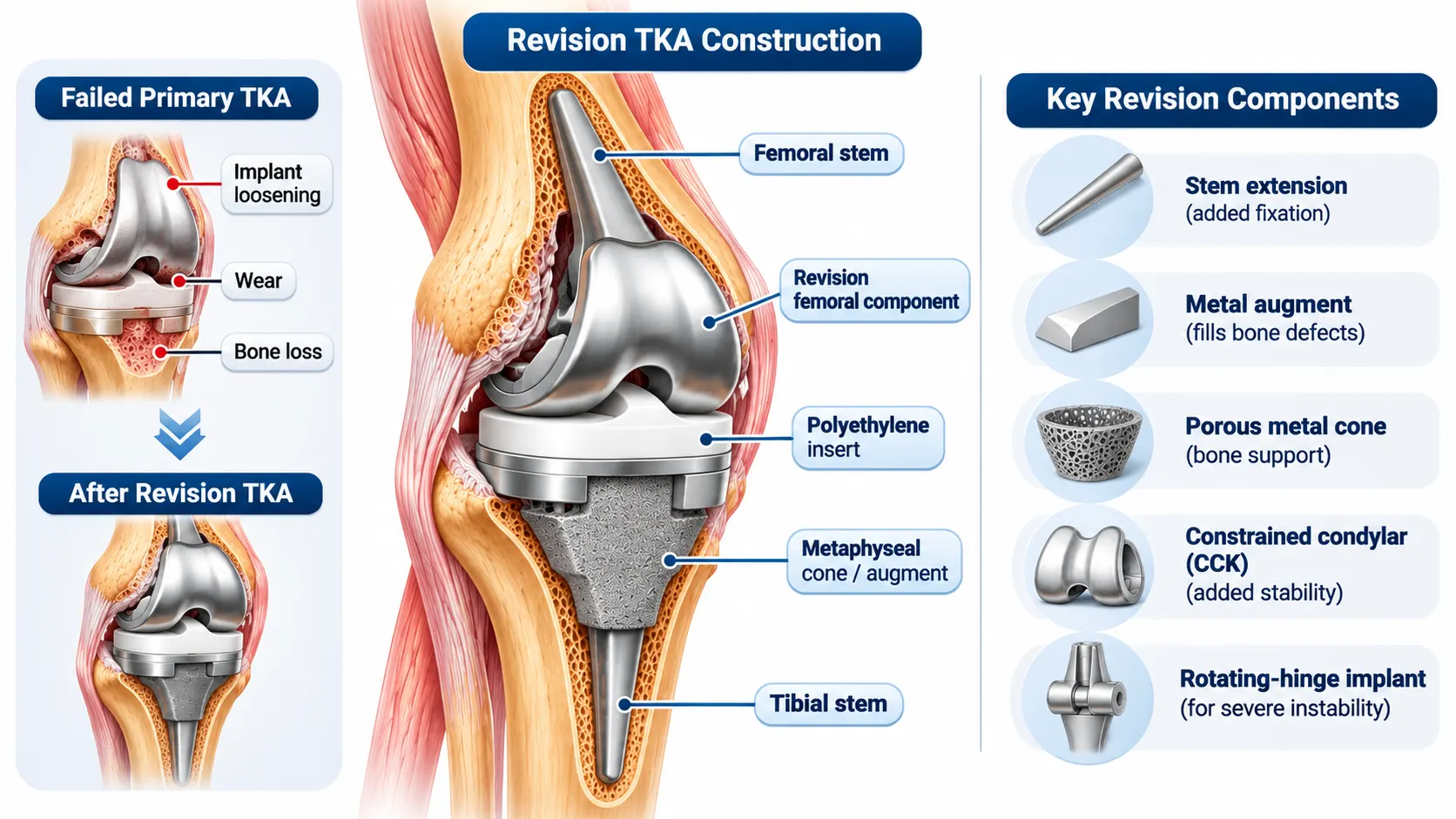
Illustration for educational purposes only. Implant designs and reconstructive techniques are illustrative and may vary according to individual patient anatomy and clinical requirements
Key Takeaways
- Identifying the reason for implant failure is the starting point for successful revision.
- Bone loss and ligament damage can make reconstruction more complex.
- Stems, augments, cones and sleeves help address different bone defects.
- Implant constraint should match the patient’s stability needs.
- The goal is to reduce pain, restore function and help patients move with confidence.
Why Do Knee Replacements Fail?
Understanding the reason behind implant failure is the first step towards successful revision. A 2025 systematic review involving more than 1.38 million revision procedures identified periprosthetic joint infection (PJI) and aseptic loosening as leading documented causes, accounting for 22.3% and 20.5% of cases, respectively [1].
Infection: A challenging complication
Periprosthetic joint infection is among the most difficult complications following knee replacement. Bacteria can form biofilms on implant surfaces, making infections difficult to eliminate with antibiotics alone. Symptoms may include persistent pain, swelling, wound drainage, fever or reduced knee function. Treatment depends on infection timing, the responsible organism, implant stability and surrounding tissue condition. Options include debridement with implant retention, single-stage revision or two-stage revision.
Aseptic loosening: When fixation is lost
Aseptic loosening occurs when an implant loses its attachment to surrounding bone without infection. Mechanical overload, inadequate fixation, osteolysis and progressive bone loss may contribute. Patients commonly experience increasing pain during weight-bearing and difficulty walking.
Instability and malalignment
A knee replacement must remain stable throughout movement. Ligament imbalance, component malposition and inadequate soft-tissue tension can cause instability. Patients may experience giving way, recurrent swelling or difficulty climbing stairs. Simply inserting a thicker polyethylene liner may not resolve the problem; the underlying cause must be addressed.
Other causes
Polyethylene wear, osteolysis, stiffness, patellar complications and periprosthetic fractures can also lead to revision surgery [2].
What Makes Revision Surgery Challenging?
Revision TKA involves reconstructing a knee that may have already lost important anatomical and mechanical support.
Bone loss is a major concern. Removing existing components can expose substantial defects, while previous operations, infection and osteolysis may further compromise available bone. Surgeons must establish reliable fixation while preserving as much remaining bone as possible.
Ligament damage creates another challenge. When collateral ligament function is compromised, achieving stability becomes difficult. Insufficient implant constraint may leave the knee unstable, whereas excessive constraint can transfer greater forces to the implant-bone interface.
Restoring alignment, component rotation, joint-line height and balanced flexion-extension gaps is equally important. Previous surgery may also leave scar tissue and stiffness, making exposure and implant removal more demanding. Safe removal is essential to avoid unnecessary bone loss and damage to surrounding structures [3].
Choosing the Right Implant
Modern revision knee systems offer several options for addressing bone defects, instability and fixation problems. However, no single implant is suitable for every patient.
Stem extensions provide additional fixation within the femoral and tibial canals, helping distribute loads and improve construct stability. Cemented, press-fit or hybrid fixation may be considered depending on the clinical situation.
Metal augments and wedges help compensate for bone defects and restore component position and joint-line height when standard components cannot provide adequate support.
Porous metal cones and sleeves are useful in substantial metaphyseal bone loss. Their porous surfaces encourage biological fixation, providing additional support where conventional fixation may be insufficient.
Constrained condylar knee (CCK) implants provide increased stability when collateral ligament function is compromised but sufficient soft-tissue support remains.
Rotating-hinge implants offer a higher level of constraint for severe ligament deficiency or major instability. However, greater constraint also places additional demands on fixation, making appropriate component selection essential.
In cases of extensive bone loss, distal femoral or proximal tibial replacement systems may be necessary to restore structural continuity.
Within this evolving landscape of revision knee reconstruction, Biorad Medisys offers two revision systems designed to address different levels of instability. The GENIUS EVOCON features a progressively constrained design, allowing controlled rotational movement during flexion while providing stability in extension [4]. For more complex cases requiring greater constraint, the GENIUS ROTACON incorporates a rotating hinge mechanism to address severe instability and ligament deficiency. Both systems reflect a design approach focused on balancing stability, bone preservation, fixation and reconstructive flexibility, with compatibility for stems, augments and metaphyseal reconstruction options to address varying bone defects. Together, these systems provide different reconstructive options based on the stability and structural requirements of the revision knee [5].
The guiding principle is to use the least level of constraint that reliably restores stability while achieving adequate fixation. More constraint does not automatically mean better reconstruction [6].
What Should Patients Expect?
Patients considering revision surgery often have practical concerns: Will the pain improve? Will walking become easier? Will recovery take longer than after the first operation? Could another revision become necessary?
Recovery is generally more demanding than after primary knee replacement, although outcomes vary according to the reason for revision, overall health, previous operations and reconstructive complexity.
The objective is to achieve a stable, functional and relatively pain-free knee, rather than promise a completely normal joint.
For surgeons, successful reconstruction involves accurate diagnosis, infection management, careful preoperative planning, restoration of bone stock, soft-tissue balancing and durable fixation. A 2024 review of re-revision TKA also highlighted infection and periprosthetic fracture as important causes of subsequent implant failure [7].
Moving Towards Better Outcomes
Advances in implant design, porous metal reconstruction and imaging technologies continue to expand the options available for complex revision surgery. Three-dimensional planning may also help surgeons understand individual anatomy and prepare for challenging reconstructions.
Nevertheless, technology alone cannot guarantee success. Identifying the original failure mechanism, preserving available bone, restoring biomechanics and selecting appropriate implants remain central to successful revision.
Ultimately, revision knee arthroplasty is about more than replacing a failed implant. It is about understanding what went wrong, rebuilding what has been lost and helping patients regain confidence in movement.
References
- [1] Why Are Primary Total Knee Arthroplasties Failing? A Systematic Review and Meta-Analysis. Journal of Arthroplasty. 2025. https://doi.org/10.1016/j.arth.2025.05.014
- [2] Evolving Etiologies and Rates of Revision Total Knee Arthroplasty: A 10-Year Institutional Report. Arthroplasty Today. 2022. https://doi.org/10.1186/s42836-022-00134-7
- [3] Four Challenges in Revision Total Knee Arthroplasty: Exposure, Safe and Effective Component Removal, Bone Deficit Management, and Fixation. 2020. PMID: 32032058. https://pubmed.ncbi.nlm.nih.gov/32032058/
- [4] Bio-Rad Medisys. GENIUS EVOCON: Progressively constrained revision knee system [Internet]. Available from: https://www.orthovasive.com/product/genius-evocon/
- [5] Bio-Rad Medisys. GENIUS ROTACON: Rotating constrained revision knee system [Internet]. Available from: https://www.orthovasive.com/product/genius-rotacon/
- [6] Prostheses Option in Revision Total Knee Arthroplasty, from the Bench to the Bedside: (1) Basic Science and Principles. 2022. https://doi.org/10.1530/EOR-21-0089
- [7] Re-revision Total Knee Arthroplasty: Causes, Risk Factors and Results. 2024. https://doi.org/10.22038/abjs.2024.75456.3490
Frequently Asked Questions
It is surgery to replace or reconstruct some or all components of a previous knee replacement because of problems such as infection, loosening or instability.
Infection and aseptic loosening are leading documented causes, although the pattern varies across studies and populations.[1]
Often, yes. Bone loss, scar tissue, ligament deficiency and difficult component removal can make reconstruction more demanding.
Options include stems, augments, cones, sleeves, CCK implants, rotating hinges and, in selected cases, megaprostheses.
Yes. Further revision is possible. Careful diagnosis, appropriate implant selection, infection management and rehabilitation are important.






Deje un comentario