






The quest for the “forgotten joint” in total knee arthroplasty (TKA) has led surgeons and researchers to move beyond simple mechanical hinges toward designs that mimic natural kinematics. Central to this evolution is the medial pivot (MP) concept. But does the design truly offer a clinical advantage, or is it merely an elegant theory?
The Kinematic Argument
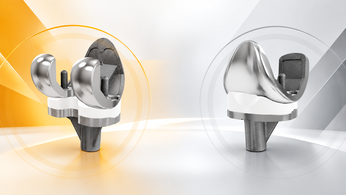
In a healthy, native knee, the medial femoral condyle remains relatively stationary during flexion, acting as a stable ball-and-socket, while the lateral condyle translates posteriorly. This “medial pivot” mechanism is essential for maximizing range of motion and quadriceps efficiency. Traditional TKA designs, such as posterior-stabilized (PS) or cruciate-retaining (CR) models, often feature symmetrical geometries. These can lead to “paradoxical anterior slide,” where the femur slides forward during flexion, causing a sensation of instability. The medial pivot design addresses this by using a highly congruent medial insert to provide a fixed rotation point, effectively restoring more natural movement and improving sagittal-plane stability.
Clinical performance and patient preference. The logic of the MP design is increasingly validated by patient-reported outcomes. Systematic reviews and meta-analyses have shown that MP designs result in significantly improved Forgotten Joint Scores (FJS) and range of motion when compared to traditional cruciate-retaining or posteriorstabilized designs.3,4 Patients frequently report that MP knees feel more “natural” and stable during demanding tasks, such as stair climbing or rising from a chair. Furthermore, long-term survivorship data is robust. Studies tracking MP cohorts over 11 to 15 years show cumulative success rates exceeding 97% for revision for any reason. This suggests that the increased congruency of the medial compartment does not compromise implant longevity, providing a reliable solution for end-stage osteoarthritis.
Conclusão
The medial pivot concept makes sense because it prioritizes kinematic fidelity. While traditional designs are successful at pain relief, the MP design addresses the functional nuance viz. stability, proprioception, and natural “feel” that modern, active patients demand. By stabilizing the medial side and allowing the lateral side to move freely, it successfully bridges the gap between mechanical replacement and biological restoration.
Bibliography
- Samad A, Marwan YA, Al-Sayer AY, et al. Medial pivot total knee arthroplasty. Cureus.2025;17(10):e12547263.
- Puttock D, Pradhan A, et al. Medial pivot designs result in improved patient reportedoutcome measures and range of motion when compared to cruciate retaining total kneereplacements: A systematic review and meta-analysis. Journal of Clinical Orthopaedics and Trauma. 2026;12885310.
- Pattnaik M, et al. Comparative study of outcomes with total knee arthroplasty: medial pivotprosthesis vs posterior stabilized implant. Prospective randomized control. Journal of Orthopaedics.
- Risitano S, Cacciola G, Capella M, Bosco F, Giustra F, Fusini F, Indelli PF, Massé A, Sabatini L.Comparison between gaits after a medial pivot and posterior stabilized primary total kneearthroplasty: a systematic review of the literature. Arthroplasty. 2023 Mar 17;5(1):15. doi:10.1186/s42836-023-00165-8. PMID: 36927464; PMCID: PMC10022170
- Karachalios T, Varitimidis S, Bargiotas K, Hantes M, Roidis N, Malizos KN. An 11- to 15-yearclinical outcome study of the Advance Medial Pivot total knee arthroplasty: pivot kneearthroplasty. Bone Joint J. 2016 Aug;98-B(8):1050-5. doi: 10.1302/0301-620X.98B8.36208. PMID: 27482016.
Frequently Asked Questions
Medial pivot implants are designed to more closely reproduce the natural kinematics of the knee. In the native knee, the medial femoral condyle remains relatively stable while the lateral condyle moves posteriorly during flexion. Medial pivot designs aim to replicate this movement by providing greater medial stability while allowing lateral-side motion.
The biomechanical concept is based on creating a stable medial compartment that acts as a pivot point, while allowing greater movement on the lateral side. The highly congruent medial insert is intended to provide sagittal-plane stability and support a more natural flexion pattern, resembling the medial stability and lateral translation seen in the native knee.
Medial pivot implants are designed to provide greater medial stability, controlled rotation, and more physiological femoral movement during flexion. By stabilizing the medial compartment while allowing lateral translation, they may help reduce paradoxical anterior femoral movement and support functional activities requiring knee flexion, such as stair climbing and rising from a chair
The medial pivot concept is considered important because it aims to replicate key aspects of native knee kinematics, with greater stability in the medial compartment and controlled movement on the lateral side. By supporting a more physiological pattern of femoral motion during flexion, medial pivot designs may help improve stability, functional movement, and the overall feel of the replaced knee.







Deixe um comentário