


Some people have an unusual tangle of blood vessels in the brain without knowing it. In certain cases, this can cause serious problems. Liquid embolization is one treatment doctors may use to block selected abnormal vessels from inside the bloodstream, without opening the skull for the embolization procedure.
Key Takeaways
- A brain arteriovenous malformation (AVM) is an abnormal tangle of blood vessels where arteries connect directly to veins.
- Some AVMs cause no symptoms, while others may lead to seizures, headaches, or bleeding.
- Liquid embolization delivers a special medical material into selected abnormal blood vessels.
- The treatment may reduce blood flow through an AVM and can be used alongside surgery or focused radiation treatment.
- The best treatment depends on the AVM and the person’s health and individual risks.
What Is an Arteriovenous Malformation (AVM)?
An arteriovenous malformation (AVM) is an abnormal network of blood vessels in which arteries connect directly to veins without the usual network of tiny blood vessels in between. This changes how blood flows through the affected vessels. 1
Some AVMs remain unnoticed for years, while others may cause symptoms or bleed into the brain. The risks vary from person to person.
Why Can a Brain AVM Be Dangerous?
Some people with an AVM experience seizures, headaches, or other problems, while others discover it during a brain scan for an unrelated reason. 1
In some cases, an AVM can rupture and cause bleeding in the brain, leading to serious complications.
A sudden, severe headache, new weakness, trouble speaking, a seizure, or loss of consciousness requires urgent medical attention. Doctors use brain scans and, when needed, detailed images of the blood vessels to understand the AVM before recommending treatment.
What Is Liquid Embolization?
One treatment option is endovascular embolization. This is a procedure in which doctors reach abnormal blood vessels from inside the bloodstream using a thin, flexible tube called a catheter. 2
Using medical imaging as a guide, the doctor moves the catheter towards the AVM and delivers a carefully selected material into parts of the abnormal vessel network.
Some liquid materials harden or form a plug after they are delivered, blocking blood flow through the treated vessels. This can reduce flow through parts of the AVM and may help prepare it for another treatment. 2
Because the catheter travels through blood vessels, doctors do not need to open the skull to perform the embolization procedure. However, it requires specialised training and careful planning.
How Can Embolic Liquid Help?
The purpose of embolization depends on the AVM and the person’s treatment plan. It may be used to reduce blood flow through selected abnormal vessels or to prepare the AVM for surgery or focused radiation treatment. 2
Embolization does not always remove the entire AVM. Some people need additional treatment, and follow-up scans help doctors check whether abnormal vessels remain.
As with any medical procedure, there are risks, including bleeding, stroke, or damage to nearby blood vessels. Specialists assess these risks against the potential benefits before recommending treatment. 2
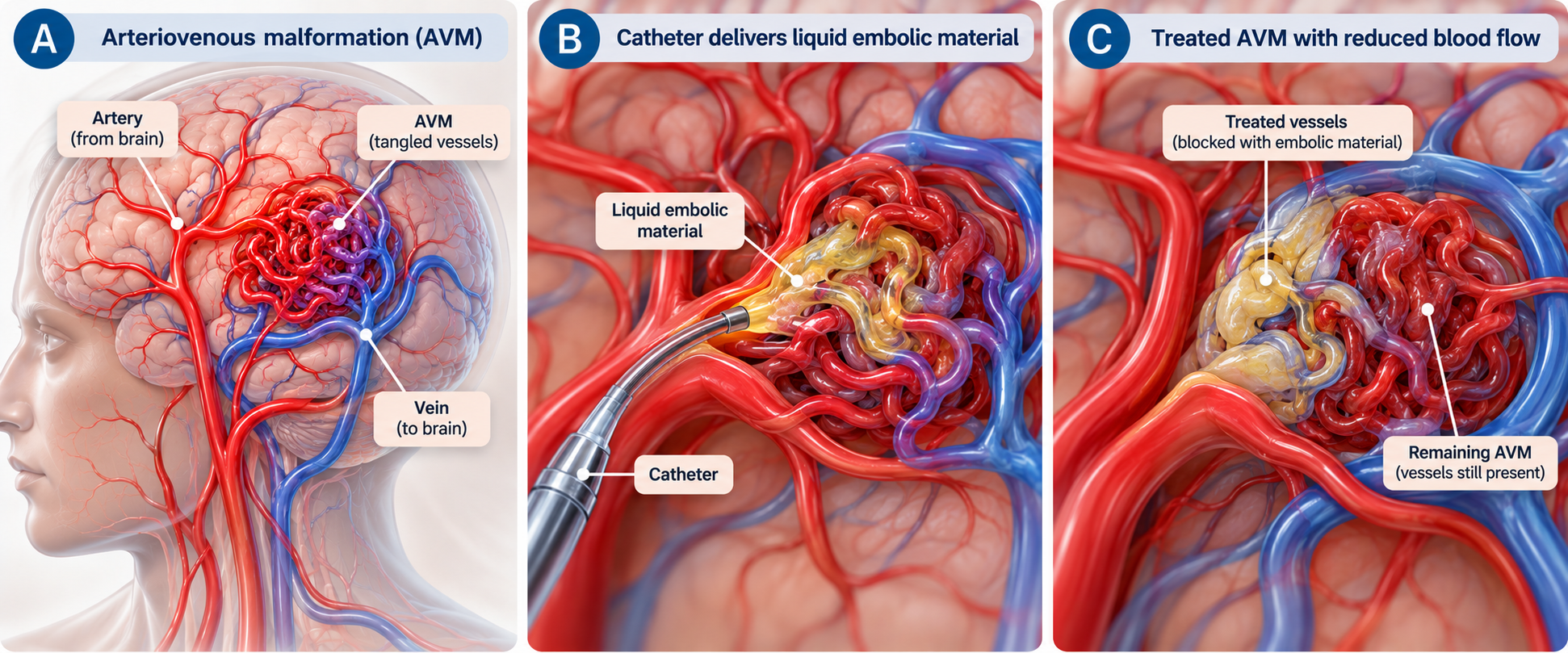
Illustration for educational purposes only. It is not intended to represent exact clinical anatomy or procedural outcomes. Clinical accuracy may vary.
Is Liquid Embolization Suitable for Everyone?
No. The most appropriate treatment depends on the AVM’s size, location, shape, blood supply, whether it has bled before, and the person’s overall health. 1,2
Depending on these factors, doctors may recommend embolization, surgery, focused radiation treatment, monitoring, or a combination of approaches. The decision is made individually, weighing the potential benefits against the risks.
Treating Abnormal Blood Vessels with Precision
Liquid embolization offers one way to treat selected abnormal blood vessels in the brain without opening the skull for the embolization procedure. However, it does not always eliminate the entire AVM.
Specialist assessment and follow-up are essential to determine the most appropriate treatment and monitor the outcome.
References
- National Institute of Neurological Disorders and Stroke. Arteriovenous Malformations (AVMs). Available from: https://www.ninds.nih.gov/health-information/disorders/arteriovenous-malformations-avms
- De Leacy R, Ansari SA, Schirmer CM, et al. Endovascular treatment in the multimodality management of brain arteriovenous malformations: report of the Society of NeuroInterventional Surgery Standards and Guidelines Committee. J Neurointerv Surg. 2022;14(11):1118–1124. https://doi.org/10.1136/neurintsurg-2021-018632
Frequently Asked Questions
No. AVM is an abnormal network of blood vessels, not a tumor. 1
No. Some AVMs are found by chance, while others may cause seizures, headaches, or bleeding. 1
No. Doctors use a catheter passed through blood vessels. It is still a specialised procedure that requires careful planning. ²
No. It may block selected vessels or part of the AVM. Additional treatment may be needed. ²
Yes. Scans help doctors check the result, see whether abnormal vessels remain, and decide if further treatment is needed. ²








Deje un comentario